
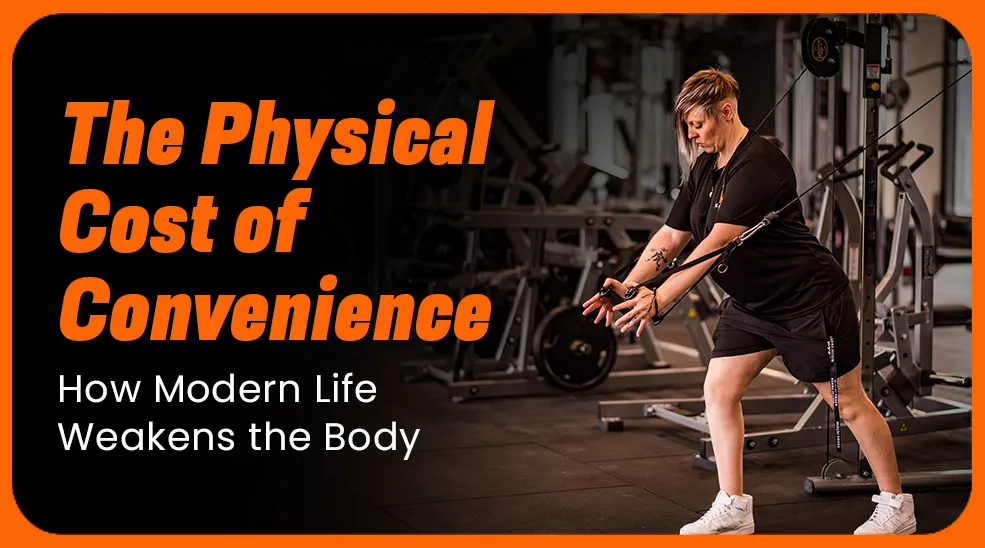
Life today is all about convenience. You get your meals straight to your home, working is done from a nice seat, and watching something or playing a game is just a matter of clicking the button on the screen. Time is saved with all this convenience but it is silently taking away the body of humans. It is not only a lack of regular movement that causes many of the most common health problems today, but also accidents and illnesses.
The human body has always been able to move, lift, stretch, and adapt. Gradually, the total body power, moving ability, and toughness are all reduced when there is no more motion. It is necessary to know how much of a negative impact convenience has on health and physical fitness first before taking any steps to reverse the situation.
Life some decades back was physically strenuous. Walking, grocery carrying, stair climbing, and doing manual tasks were all part of the everyday life. Nowadays, cars, lifts, remote controls, and online services eliminate almost all the physical demand.
At first movement reduction might seem trivial but gradually it leads to muscle weakening, joint mobility decrease, and energy levels drop. Even those who work out from time to time can still feel these effects if their majority of the day is spent in a sitting position. The problem is not that people are lazy — it is that contemporary systems do not require the body to perform anymore.
It is a gradual process, and muscle strength decreases very naturally as the years go by, however, lacking movement makes this process die out much faster than expected. The absence of any form of exercise involving resistance or weight-bearing makes the body start losing muscle and bone mass much earlier than it is expected.
This loss not only alters looks. Muscles that are not sufficiently strong, lead to less support for the joints, poor balance, and more susceptibility to injuries. Thus, simple actions like lifting objects, climbing stairs, or even keeping the right body position become more difficult. If left untreated, this decline can result in the loss of independence and a corresponding drop in one’s quality of life.
Sitting for a long time, especially in a bad manner, puts a constant strain on the spine, hips, and arms. Today, problems like tight hip flexors, hunched shoulders, and stiff backs are not uncommon among people of all ages.
If joints do not move through their full range regularly, they become less flexible and lose their flexibility. Pain, stiffness, and chronic discomfort may follow as a result. A lot of people think of "normal pain" as something coming from overuse when it is actually the body reacting to underuse.
Convenience is not only the reason for muscle reduction but also an issue for the body's energy metabolism. Long hours of sitting lead to decreased insulin sensitivity, low metabolic rate, and blood flow disruption. Consequently, these factors make one prone to obesity, tiredness, and the development of diseases that are related to lifestyle choices.
However, people who look perfectly healthy can have undetected metabolic problems if they do not move. Movement helps the body to regulate sugar levels, increase the efficiency of blood flow, and promote heart's health. In contrast, the body's ability to work properly is heavily impaired without physical activity.
The price of comfort is not only paid by the body. The relationship of movement to mental health is very close. The usual physical training brings along advantages such as a good mood, managing stress, and thinking clearly.
In the absence of motion, stress goes up and energy goes down. A lot of people suffer from mental tiredness not as a result of too much work but because of too little activity. Regular exercise plays a significant role in the production of healthy hormones and, moreover, in the betterment of sleep, which in turn, supports overall health.
Reversal of the damage done by convenience does not require extreme training or drastic lifestyle changes. What is important is the consistency and variety of physical activities. Muscle strengthening helps rebuilding of muscles and support of joints, while cardio improves the condition of the heart and the flow of blood. Exercises with a focus on mobility are aimed at going back to the full range of motion and decreasing stiffness.
The idea is to bring movement back into the life of a person daily — not only during workout sessions but also throughout the day. Standing up more regularly, walking occasionally and conditioning the body to move in different ways all greatly help in neutralizing the effects of a sedentary lifestyle.
A comprehensive fitness strategy comprising strength, mobility, and recovery can gradually result in restored physical hardiness. With the help of properly skilled professionals and the availability of suitable training facilities, many individuals come to realize that they have not only regained strength, energy, and confidence but have also done so without realizing it.
Undoubtedly, technological advancements have brought about a lot of convenience in the daily lives of people; however, human physiology has also been negatively impacted to a certain degree. The deterioration of physical strength is so gradual and imperceptible that people often overlook it until they feel discomfort, tiredness, or have an injury. One good thing about this process is that the human body gets used to the movements so fast that it will not take long to get back to normal if movement is reintroduced.
A combination of regular workouts, functional training, and deliberate movements are among the ways to combat the slow but sure draining of our physical strength by modern life. If you choose to be more active, you not only improve your physical fitness but also get a guarantee of your long-term health, independence, and quality of life.
Ready to move better and feel stronger? Visit Kahma Clyde North to explore flexible memberships, expert trainers, and a gym designed to support real, long-term health.


