
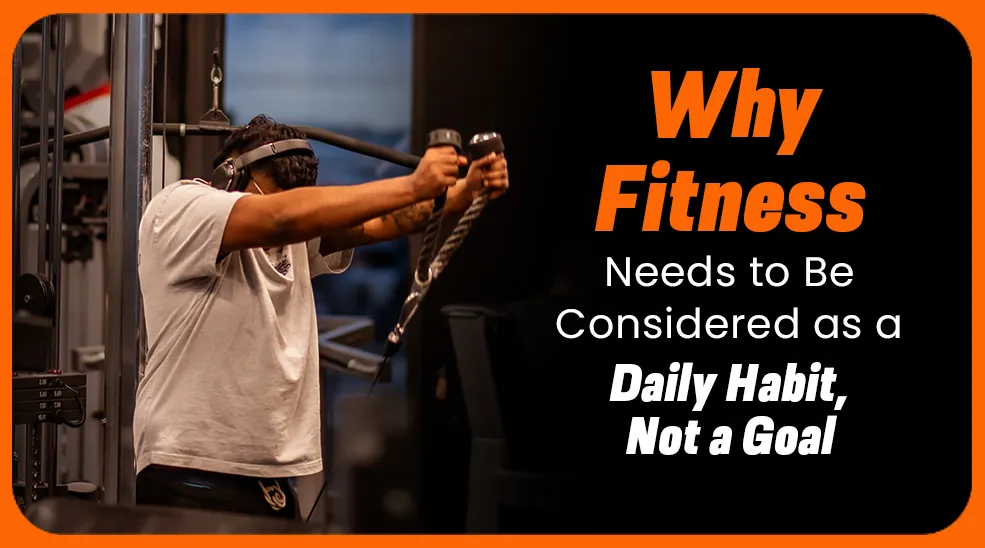
A lot of people looks at the fitness journey as a process with a endpoint—losing a certain weight limit, getting toned, or having a short-lived transformation. Although goals can be motivating, they also lead to an “all-or-nothing” attitude. Once the goal is achieved, the regularity is no more.
If you want to benefit the most from fitness, it should be treated as a daily habit, similar to tooth brushing or meal eating. It’s not a process that comes to an end—it’s a process that you keep doing. This change in attitude is what mainly distinguishes between results that last for a short period and health that lasts for all time.
Setting goals isn’t the problem—relying only on goals is. When fitness is tied to deadlines or outcomes, motivation depends heavily on visible progress. If results slow down or life gets busy, workouts are often the first thing to be skipped.
The human body does not react positively to stop-and-go patterns. Long intervals between workouts lead to a decrease in strength, stamina, and, most importantly, self-assurance. Gradually, fitness becomes linked to stress rather than fun and it is then that people find it most difficult to be consistent.
A habit-based approach removes the pressure to “achieve” something every session. Instead, showing up becomes the win.
Motivation cannot be depended upon. It shows up and disappears depending on one's emotional state, stress, and energy level. The opposite is true for habits; they will still be there even if the motivation is not strong.
Once fitness is integrated into your life, workouts will still take place no matter what your feelings are that day. This regularity dries up the long-term improvement of strength, mobility, and mental well-being.
Those who have made a routine of exercising see not only their physical changes but also the following, among other benefits—sleep quality improvement, better handling of stress and of course, more daily energy. These benefits are not the result of an occasional effort but of consistent and sometimes even imperceptible actions.
The human organism is designed to produce daily motion. Regular physical activity not only benefits joints, blood flow, and muscle power but also improves posture. On the other hand, the inactivity problem is manifested through stiffness, fatigue, and pain.
Daily workout trends help in achieving the right mix of workouts—strength, cardio, stretching, and rest. As a result, the injury risk is low, and the acquisition of the benefits is gradual.
Here, access is an important factor. It becomes easier to keep up with training when there are no restrictions on schedules. Many individuals experience that selecting the top gym in Clyde North with round-the-clock access eliminates usual hurdles like lack of time, thus making it easier to follow a schedule.
One week of intense workouts won’t reverse the effects of months of inactivity. Nevertheless, the permanent transformation comes from consistent, prolonged moderate training. Habit-based fitness concentrates on doing what you are capable of doing, but doing it consistently.
This way of working out does not lead to burnout and allows the body to get used to the process safely. There is a gradual increase in power, better health of the joints, and quicker recovery. Besides, it is a flexible arrangement—missing one session does not count as a failure, since the habit goes on the next day.
Personal trainers help Clyde gym members' trust, which is very important to this attitude, as they will be the ones to establish the routines based on each individual's lifestyle instead of imposing unrealistic plans.
Fitness habits are not only limited to training. Recovery is treated as well. Sleeping, taking water, stretching, and resting are all helping to get the right movement.Making recovery a part of the daily routine allows the body to repair and recharge.
Using a steam bath or sauna, which is appreciated by the Clyde North fitness community, can facilitate muscle recovery, blood circulation, and stress relief when used properly.
Once recovery becomes a regular thing, people will have less soreness, sleep will be of better quality, and their training performance will be enhanced.
Making fitness a lifestyle means removing all the obstacles. It consists of daily physical activity instead of seeing it as an extra burden that is not very important.
There are some very simple changes in lifestyle, for instance, always working out at the same time, training at easy-to-find locations, and focusing on the progress made rather than the perfection should be the goal, can help make fitness a lifelong commitment. The routine eventually becomes self-reinforcing.
It’s no longer the case of inquiring “Did I attain my goal?” but rather the case of “Was there any physical activity done by me today?” This alteration in thinking has caused a very favorable view of physical activity to be formed—usually a bond that is characterized by regularity, not stress.
Fitness ought to be considered as a daily routine instead of a goal to be achieved at the end. When someone becomes accustomed to doing physical activity regularly, it will not be perceived as a laborious task anymore and the advantages of fitness will be automatically experienced. One of the outcomes of the fitness journey is stronger muscles, more energy, and better health even in old age.
No more short-term goals to achieve, solely sustainable habits to accumulate, and then fitness is a lifestyle that you live rather than a goal that you keep pursuing. The fittest ones are not created through intense hard work but rather through a patient and constant commitment, one day at a time.


